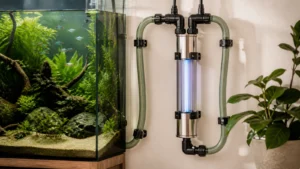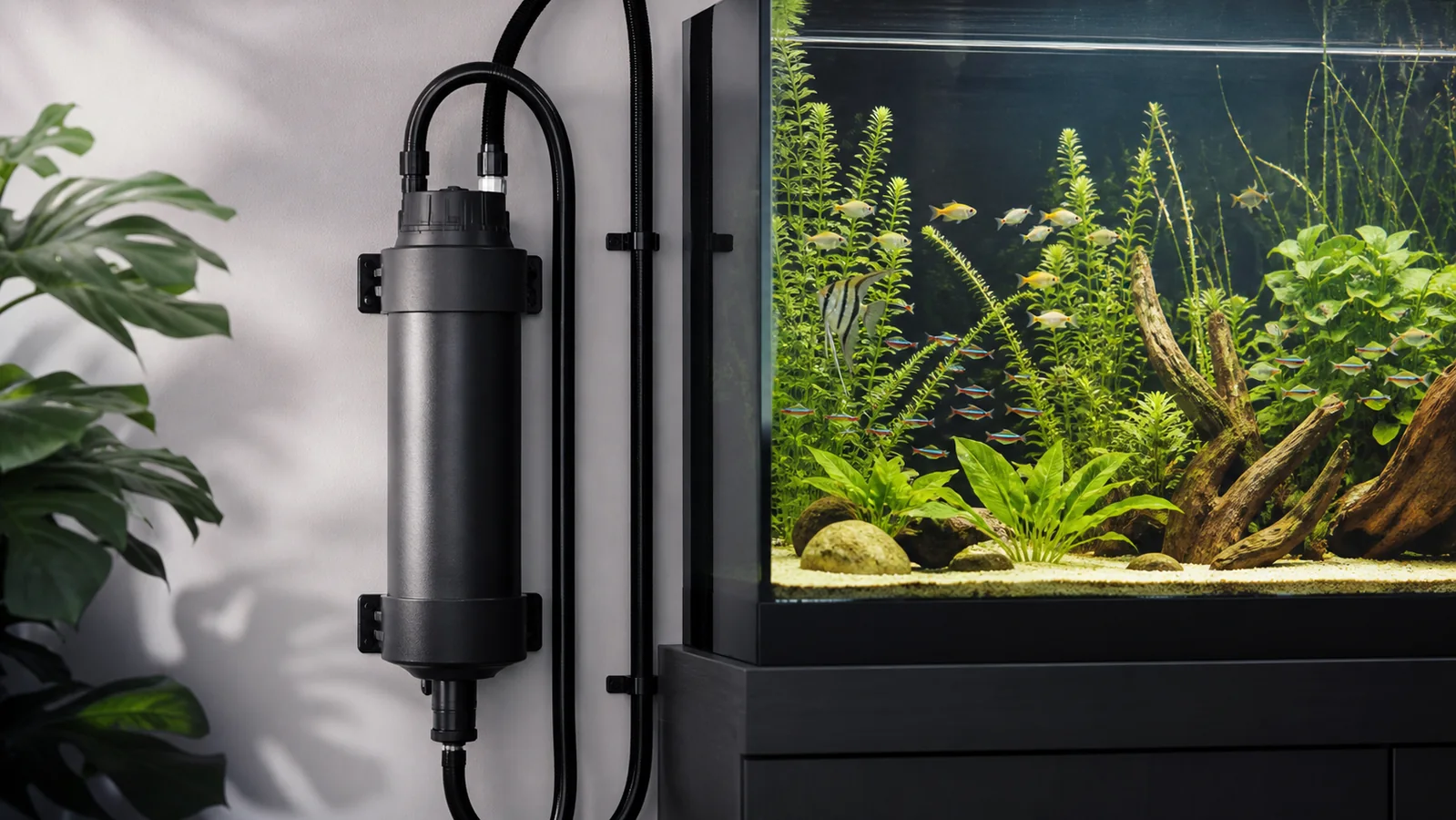
An aquarium UV unit exposes water passing through its chamber to ultraviolet energy. Correctly sized and operated, it may help manage free-floating algae or some waterborne organisms. It cannot treat organisms attached to fish, substrate, glass or decor, and it does not make an aquarium maintenance-free.
What UV does and does not do
| Can help | Cannot replace |
|---|---|
| Reduce some free-floating algae | A completed nitrogen cycle |
| Reduce certain organisms passing through | Quarantine and disease diagnosis |
| Improve water clarity in suitable cases | Water changes and debris removal |
Installation decisions
- Identify the specific problem before buying.
- Check aquarium volume and the maker’s dose/flow table.
- Account for real pump flow and plumbing resistance.
- Install where the chamber remains full and cannot run dry.
- Prevent all direct eye/skin exposure to UV.
- Track bulb age and clean the quartz sleeve as instructed.
During medication and cycling
Some treatments or beneficial bottled organisms may require UV to be turned off temporarily. Follow the medication and UV manufacturer instructions. A UV unit does not replace seeded biological media and should not be used as proof that a new aquarium is cycled.
Related PetUpon guides
Compare aquarium UV sterilizers and review routine maintenance.
Dose is the real specification
UV performance depends on lamp output, chamber geometry, water clarity and how long water remains exposed. Manufacturers may publish different recommended flows for clarification and for control of more resistant organisms. Use the table for the exact model and purpose. A pump’s box rating is not necessarily the flow through the UV after plumbing head and restrictions.
When UV is a reasonable tool
A properly configured unit may help a persistent green-water bloom after husbandry causes are corrected, or reduce transmission opportunities for some free-floating stages in a multi-tank or high-risk setting. It is not a first response to ammonia, nitrite, overfeeding, dirty substrate or a sick fish. Those problems require water testing, maintenance, quarantine and diagnosis.
Installation and service log
| Item | Record |
|---|---|
| Lamp installation | Date and rated useful hours |
| Quartz sleeve | Inspection/cleaning date |
| Actual plumbing | Pump, valves, head and target flow |
| Result | Clarity or problem trend before/after |
Critical safety rules
- Never look at an operating UV lamp or expose skin to it.
- Disconnect power before opening or servicing the chamber.
- Do not run the lamp in a dry or leaking housing.
- Replace seals and lamps with compatible parts.
- Dispose of mercury-containing lamps under local requirements.
A lamp may continue to glow after its useful UV output has declined, so visual inspection cannot prove effectiveness.
How to verify that the change is working
Change one variable at a time and record the starting condition before adjusting equipment or routine. Note water-test results, temperature, livestock behavior, feeding, visible waste or algae, and the exact setting that changed. Recheck at a consistent time rather than reacting to a single observation immediately after maintenance. This creates evidence you can compare and prevents repeated changes from hiding the real cause.
Animal behavior is an important signal but not a substitute for measurements. Normal swimming, breathing and feeding should be considered alongside ammonia, nitrite, temperature and species-specific chemistry. If animals gasp, lose balance, develop lesions or die unexpectedly, treat it as a health or water-quality problem—not an equipment shopping problem—and seek qualified help.
Responsible equipment decisions
Buy for the mature aquarium, not only its current appearance. Confirm electrical certification, warranty, replacement parts, cleaning access and the manufacturer’s operating limits. Keep manuals and purchase dates in the maintenance log. Before replacing working equipment, identify the outcome you need and the measurement that will show improvement. A more expensive device cannot correct overcrowding, incompatible livestock, untreated source water or inconsistent husbandry.
After any installation, inspect cables, drip loops, leaks, unusual heat, vibration and restart behavior. Keep electrical connections dry and disconnect power before putting hands near damaged or exposed equipment. When the manufacturer’s instructions conflict with a general rule in this guide, follow the instructions for the exact model.
Frequently asked questions
Will UV cure sick fish?
No. It only affects water that passes through the chamber and cannot diagnose or treat disease on a fish.
Should UV run 24/7?
Follow the manufacturer and the purpose of use; continuous and intermittent strategies differ. Track bulb hours either way.
Does clear water mean safe water?
No. Clear water can still contain ammonia, nitrite or unsuitable chemistry. Continue testing.
Sources and editorial notes
- Aqueon: Freshwater Aquarium Water Quality
- Aqueon: The Nitrogen Cycle
- Fluval: Choosing a Freshwater Filter
PetUpon provides general aquarium education. Species needs and equipment instructions take priority; seek an aquatic veterinarian for illness or unexplained losses.