Our verified product pick
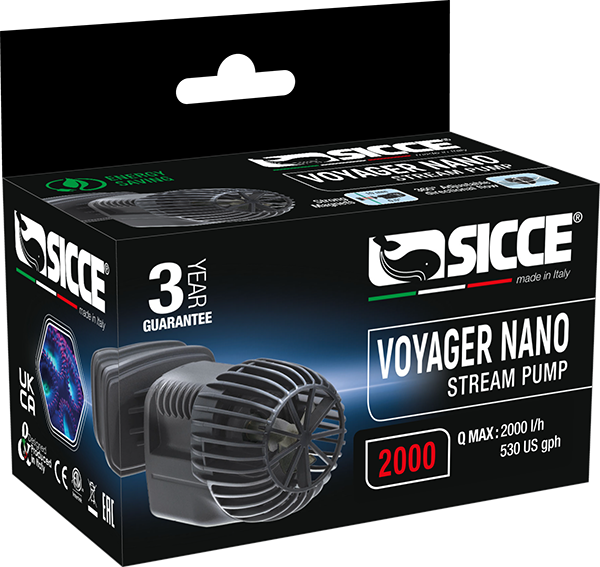
SICCE Voyager Nano 2000
| Manufacturer sizing | Freshwater 120–200 L |
|---|---|
| Published output | 2,000 L/h maximum |
| Power / type | 3 W |
| Model verification | Official product page |
Pros
Compact magnetic mount, 360-degree adjustment, freshwater/marine use.
Limitations
Fixed high output requires careful placement for flow-sensitive fish.
Editorial verdict: This is the current model we can verify directly from its manufacturer. Select the exact size/voltage for your aquarium and confirm the seller listing before checkout.
ASIN status: not hard-coded. The button uses a model-specific Amazon search with Associates tag bestforpets0c-20 so PetUpon does not send readers to an unverified or replaced listing.
Choosing aquarium powerheads is easier when you ignore old rankings and compare the factors that affect safety, reliability, and long-term ownership. PetUpon has rebuilt this guide around decision criteria rather than discontinued models or prices that can change without notice.
PetUpon recommendation
Choose for the real use case
Prioritize controllable flow, guard design, noise, mounting security, and serviceability. Confirm current specifications with the manufacturer and buy from a seller with a clear return policy. We have not hands-on tested every product discussed, so this is a research-backed selection framework rather than a laboratory ranking.
The most important safety point
Aquarium equipment should be evaluated as part of a complete life-support system. Tank volume on a box is only a rough starting point; livestock, feeding, temperature, head height, maintenance, and measured water quality change what the system needs.
Comparison checklist
| Criterion | What good looks like | Warning sign |
|---|---|---|
| Fit for purpose | Specifications match the animal, environment, and routine | A universal claim with no operating limits |
| Safety | Risks are disclosed and safeguards are practical | Marketing promises that dismiss foreseeable failure |
| Reliability | Replaceable wear parts and accessible support | No manual, parts, warranty, or company contact |
| Maintenance | Routine cleaning and inspection are realistic | Critical areas cannot be reached without major disassembly |
| Total cost | Consumables and replacements are available | Low purchase price with proprietary recurring costs |
How we would narrow the options
First define the non-negotiables: the animal’s needs, available space, environment, supervision, and budget. Remove products that cannot document those basics. Next compare current manuals rather than marketplace summaries. Finally, choose the simplest option that meets the requirement and can be maintained consistently.
Do not treat a high star average as proof. Reviews can reveal recurring noise, leaks, jams, fit problems, or poor support, but they rarely control for setup and long-term maintenance. Give more weight to repeated failure patterns and documented specifications than to a single enthusiastic or angry review.
What to verify before checkout
- Exact model number and dimensions, not a family name shared by several sizes.
- Electrical, food-contact, or material requirements relevant to the use.
- Replacement parts, consumables, warranty terms, and support contact.
- Return rules after opening or testing the product.
- Whether setup requires accessories that are not included.
Installation and the first-week test
Read the current manual and inspect every component before use. Test the product under supervision, begin at conservative settings, and keep the previous safe setup available until performance is stable. Record settings and observations for a week. A product that saves time only when it is maintained correctly; automation must not remove daily observation of the animal.
Maintenance determines long-term value
Add cleaning, inspection, and replacement intervals to a calendar. Dirt, moisture, mineral deposits, hair, food oils, worn seals, dull blades, and damaged cables can change performance. Stop using equipment that overheats, cracks, leaks, shocks, jams repeatedly, or behaves unpredictably. Contact the manufacturer rather than improvising a safety-critical repair.
Our verdict
The best aquarium powerheads is not a permanent winner for every household. It is the option that meets the defined use case, exposes its limitations, can be maintained, and continues to operate safely. Use this framework to compare models currently available in your region and re-check specifications at purchase time.
Frequently asked questions
Does PetUpon claim these products were hands-on tested?
No. Unless a page explicitly displays a verified Tested badge and test protocol, the guide is based on current specifications, primary guidance, safety considerations, and editorial research.
How often should I replace the product?
There is no universal schedule. Follow the manufacturer’s inspection and replacement guidance, monitor wear and performance, and replace any item that can no longer operate safely or consistently.
Is the most expensive option usually best?
No. Price may reflect materials, support, or features, but it does not prove fit. Pay for requirements you will use, safety, serviceability, and reliable support.
When should I ask a veterinarian or qualified professional?
Seek help when the purchase affects health, behavior, diet, habitat safety, or an existing medical problem, or whenever the animal shows distress or abnormal signs.
How to compare value without chasing a sale
Calculate the cost of the complete working setup, not just the item shown in the advertisement. Include required accessories, replacement media or parts, food or consumables, electricity where relevant, and the time needed for cleaning and supervision. A slightly higher initial price can be reasonable when parts remain available and the design is easier to maintain, but premium pricing is not evidence by itself. Save the manual, receipt, exact model number, and warranty information.
Red flags in product listings
- No exact dimensions, operating limits, materials, or model identifier.
- Absolute claims such as maintenance-free, completely safe, or suitable for every animal.
- A copied specification table that conflicts with the manufacturer’s current manual.
- No responsible company address, support route, replacement parts, or warranty terms.
- Health, behavior, or disease-treatment claims unsupported by an appropriate authority.
Editorial update policy
PetUpon reviews availability, specifications, safety guidance, and broken links when this guide is updated. A change in packaging, seller, or price does not necessarily change the recommendation framework; a safety notice, discontinued part, material change, or repeated documented failure can. Readers should always verify the current manual and local availability because product revisions can occur between editorial checks.
Sources and editorial basis
- Merck Veterinary Manual: Providing a home for fish
- Merck Veterinary Manual: Aquatic life-support components
- PetUpon editorial standards