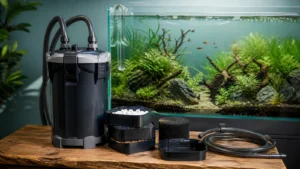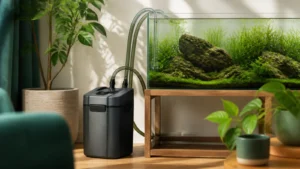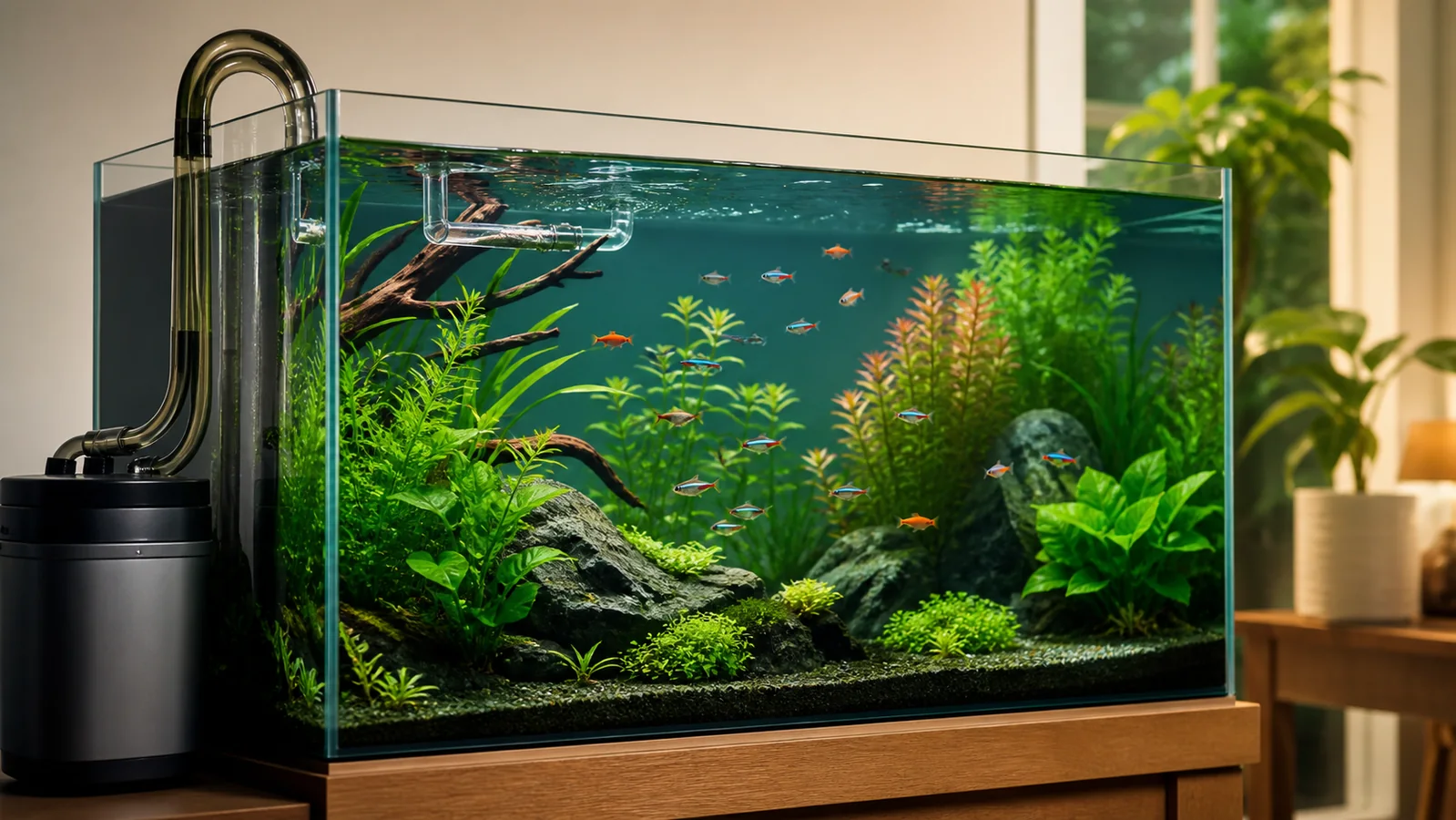
A filter should keep water moving through enough mechanical and biological media without creating stressful current. Manufacturer tank ratings are a useful starting point, but advertised flow is measured under ideal conditions and usually falls after media, hoses, lift height and debris add resistance.
What turnover means
Turnover is nominal filter flow divided by tank volume. A rough planning range such as four to six tank volumes per hour can help compare freshwater equipment, but it is not a universal target. Long-finned bettas, river fish, planted tanks and messy cichlids can need very different current and media capacity.
Size by the whole system
| Factor | Why it matters | Adjustment |
|---|---|---|
| Bioload | More waste consumes media capacity | Choose more media volume and maintain more often |
| Head height | Reduces canister/pump flow | Read the pump curve and keep hoses efficient |
| Flow-sensitive fish | Strong jets can cause stress | Use a spray bar, baffle or distributed outlets |
| Planted layout | Hardscape creates dead spots | Place intake/outlet for gentle circulation |
A safe selection checklist
- Calculate actual water volume after substrate and hardscape.
- Check the rated aquarium range and media volume.
- Confirm replacement media and parts are available.
- Plan intake safety for shrimp and fry.
- Test circulation with the tank fully furnished.
- Never replace all mature biological media at once.
Related PetUpon guides
Compare aquarium filters, canister filters, and HOB filters.
Estimate real flow instead of trusting the box
Published flow is normally a pump benchmark, not the final circulation inside a furnished aquarium. Fine pads, mature biological media, long hoses and lift height reduce output. Rather than trying to prove one exact number, check whether suspended debris reaches the intake, the surface moves gently and sheltered areas avoid becoming waste traps. Clean only the obstructed mechanical stage when flow declines; do not discard healthy biological media to restore a “new filter” appearance.
If a canister sits below the aquarium, compare the vertical distance and hose route with the maker’s installation limits. Avoid unnecessary bends, keep the intake clear and use the supplied hose diameter. For HOB filters, maintain the water level so the return does not create an unintended waterfall.
Worked planning example
For a nominal 20-gallon aquarium that holds closer to 17 gallons after substrate and rocks, a filter advertised at 100 GPH appears to provide almost six turnovers per hour. Real flow may be lower after media loads. That can still be suitable for a calm community tank if circulation reaches the whole layout; it may be inadequate for heavy waste, while the concentrated outlet may be too forceful for a long-finned fish. The answer is to balance media capacity and distribute the return—not simply chase a larger GPH label.
Decision checklist before purchase
- Does the filter hold reusable biological media?
- Can the intake be protected for shrimp, fry or long fins?
- Can the return be baffled, aimed or spread?
- Are impellers, seals and media available locally?
- Can you service it without moving the aquarium?
- Will it restart safely after a brief power interruption?
How to verify that the change is working
Change one variable at a time and record the starting condition before adjusting equipment or routine. Note water-test results, temperature, livestock behavior, feeding, visible waste or algae, and the exact setting that changed. Recheck at a consistent time rather than reacting to a single observation immediately after maintenance. This creates evidence you can compare and prevents repeated changes from hiding the real cause.
Animal behavior is an important signal but not a substitute for measurements. Normal swimming, breathing and feeding should be considered alongside ammonia, nitrite, temperature and species-specific chemistry. If animals gasp, lose balance, develop lesions or die unexpectedly, treat it as a health or water-quality problem—not an equipment shopping problem—and seek qualified help.
Responsible equipment decisions
Buy for the mature aquarium, not only its current appearance. Confirm electrical certification, warranty, replacement parts, cleaning access and the manufacturer’s operating limits. Keep manuals and purchase dates in the maintenance log. Before replacing working equipment, identify the outcome you need and the measurement that will show improvement. A more expensive device cannot correct overcrowding, incompatible livestock, untreated source water or inconsistent husbandry.
After any installation, inspect cables, drip loops, leaks, unusual heat, vibration and restart behavior. Keep electrical connections dry and disconnect power before putting hands near damaged or exposed equipment. When the manufacturer’s instructions conflict with a general rule in this guide, follow the instructions for the exact model.
Frequently asked questions
Is more GPH always better?
No. Excess current can stress animals while a high number with little useful media may not improve biological filtration.
Should I buy the exact tank rating?
Use it as a minimum comparison point, then account for livestock, head height, media loading and the maintenance interval.
Can two smaller filters replace one large filter?
They can add redundancy and distribute flow, provided their combined media and real flow suit the aquarium.
Sources and editorial notes
- Aqueon: Freshwater Aquarium Water Quality
- Aqueon: The Nitrogen Cycle
- Fluval: Choosing a Freshwater Filter
PetUpon provides general aquarium education. Species needs and equipment instructions take priority; seek an aquatic veterinarian for illness or unexplained losses.