For most households, the best automatic dog feeder is the one that dispenses repeatable portions, resists jams, keeps kibble dry, and still works safely when Wi-Fi or household power fails. After comparing current manufacturer documentation, we recommend the PetSafe Smart Feed 2nd Generation for owners who need remote scheduling and the PetSafe Healthy Pet Simply Feed for owners who prefer simpler controls without an app.
Best overall smart feeder
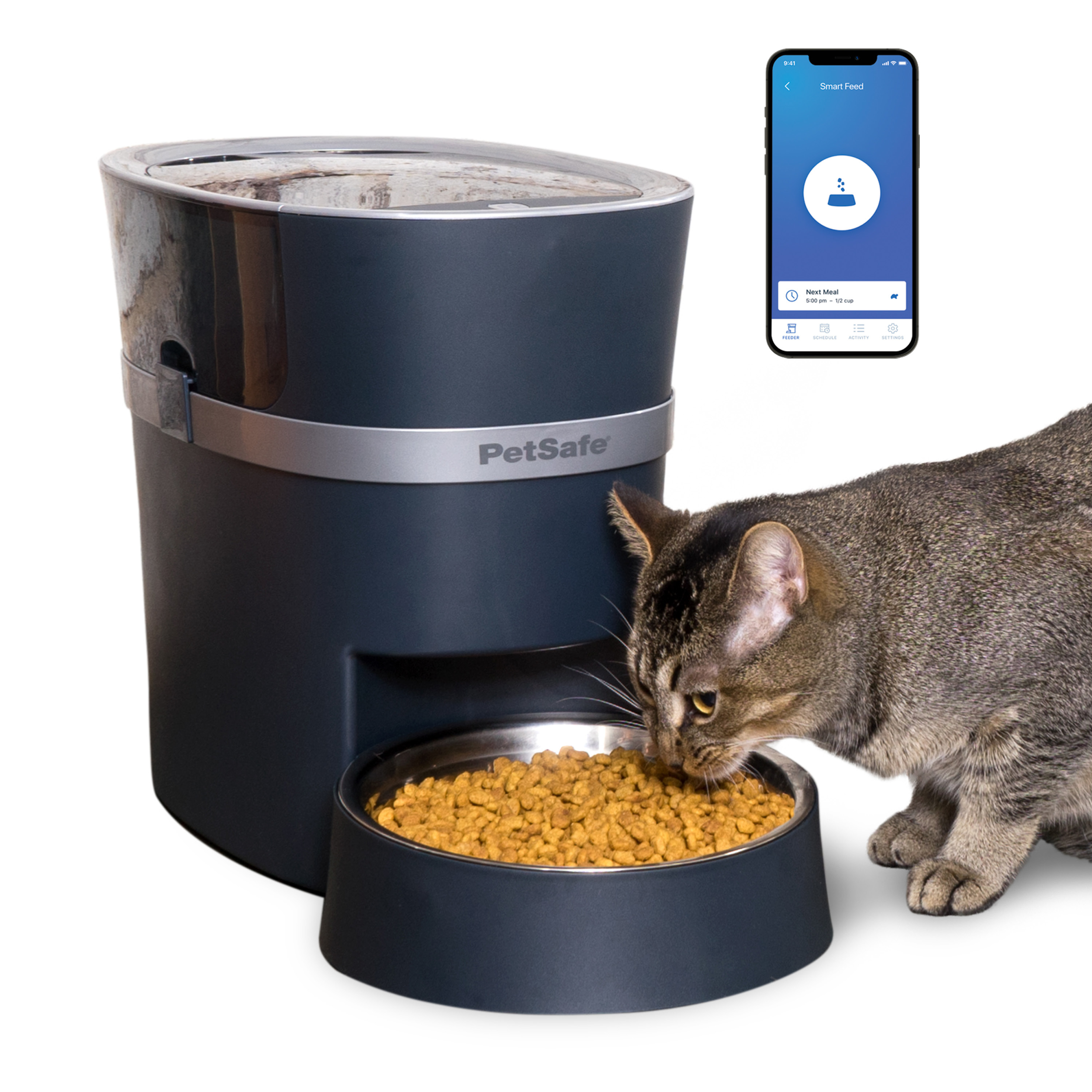
PetSafe Smart Feed, 2nd Generation
| Published capacity | 24 cups |
|---|---|
| Scheduling | Up to 12 meals; app-adjustable meal times |
| Connectivity | Wi-Fi, iPhone/Android app and Alexa support |
| Cleaning | Top-rack dishwasher-safe components |
Pros
- Remote scheduling and low-food notifications
- Large hopper for dry or semi-moist food
- Multiple family members can use the app
Cons
- Costs more than non-connected feeders
- App features depend on Wi-Fi and service availability
- Still requires daily visual checks
Verdict: The strongest fit for owners who want remote monitoring and flexible schedules, provided they test portion output with their specific kibble and keep a backup feeding plan.
Quick comparison
| Pick | Best for | Meals | Key trade-off |
|---|---|---|---|
| PetSafe Smart Feed 2nd Gen | Remote scheduling | Up to 12 | Higher price and app dependence |
| PetSafe Healthy Pet Simply Feed | Reliable offline scheduling | Up to 12 | No remote monitoring |
| PetSafe 5 Meal Feeder | Wet food or short absences | 5 compartments | Limited capacity |
How we evaluated automatic dog feeders
PetUpon compared feeders using the factors that determine whether the device remains useful after the novelty wears off: portion repeatability, resistance to kibble jams, backup power, food-contact cleaning, lid security, replacement parts, manual override, and clarity of manufacturer support. We prioritized documented capabilities over marketplace star ratings. We have not laboratory-tested every feeder, so this is a research-backed buying guide rather than a claim that every unit was hands-on tested.
Choose the feeder for your dog, not the feature list
Portion range and accuracy
Measure several consecutive servings into a kitchen scale before trusting a new feeder. Portion volume varies with kibble diameter, shape and density. A setting described as one “portion” is not a nutritional unit, so convert the dispensed amount into grams and calories using the dog-food label.
Jam resistance
Irregular, oversized or oily kibble can bridge inside a hopper or stall a dispensing mechanism. Check the manufacturer’s supported kibble size, test at least a week of scheduled meals, and confirm that the feeder reports or visibly reveals a failed serving.
Power failure protection
A battery backup is valuable, but it does not eliminate risk. Confirm whether schedules remain stored after an outage and whether the motor actually dispenses on batteries. Keep spare batteries and a manual feeding plan.
Dog-proof construction
Strong or food-motivated dogs may tip a light feeder, pry open the lid, or reach into the chute. Choose a locking hopper and stable base, and place the unit where it cannot be pushed down stairs or into water.
Setup checklist
- Wash all food-contact parts and allow them to dry completely.
- Enter the dog’s daily calorie target, then calculate grams per meal.
- Run at least ten test portions and weigh each one.
- Test the battery backup and reconnect procedure.
- Observe every meal for the first week.
- Check the hopper daily even when an app reports that food remains.
Who should not rely on an automatic feeder?
Dogs receiving insulin, medication with food, prescription diets, or tightly controlled calories need a feeding plan approved by their veterinarian. Multi-pet homes may also require microchip-controlled access or separate rooms. Puppies, dogs prone to bloat, and pets that destroy equipment need closer supervision than a standard hopper feeder provides.
Cleaning and maintenance
Food oils and crumbs collect in the hopper, rotor and chute. Empty and wash removable components on the manufacturer’s schedule, dry them fully before refilling, and inspect seals and moving parts. Do not add new kibble indefinitely on top of old food. Rotate stock, record opening dates, and stop using a feeder that overheats, cracks, dispenses unpredictably or repeatedly jams.
Frequently asked questions
Can an automatic feeder replace a pet sitter?
No. A feeder cannot assess water access, illness, injury, temperature, toileting or whether the dog actually ate. It should support—not replace—daily human care.
Will it work with wet food?
Hopper feeders are generally intended for compatible dry or semi-moist kibble. For wet food, use a compartment-style model designed for it and follow safe holding-time and temperature guidance.
How often should I test portions?
Test during setup, after changing kibble, after cleaning and whenever the dispensed amount appears different. Weigh several servings rather than trusting one sample.
Is Wi-Fi necessary?
No. Wi-Fi is useful for alerts and remote changes, but a well-designed offline feeder can be more predictable for a stable household schedule.
Bottom line
The PetSafe Smart Feed 2nd Generation is our research-backed choice for flexible remote scheduling, while the Healthy Pet Simply Feed is a sensible alternative for owners who want fewer connected features. Whichever model you choose, verify the real portion weight, test failure modes, clean it regularly, and maintain daily contact with your dog.
Continue with our dog-food selection guide, review the PetUpon review methodology, or browse more pet buying guides.


I want to buy an automatic pet feeder as you said it is essential to have it. Thank a lot for the tips!