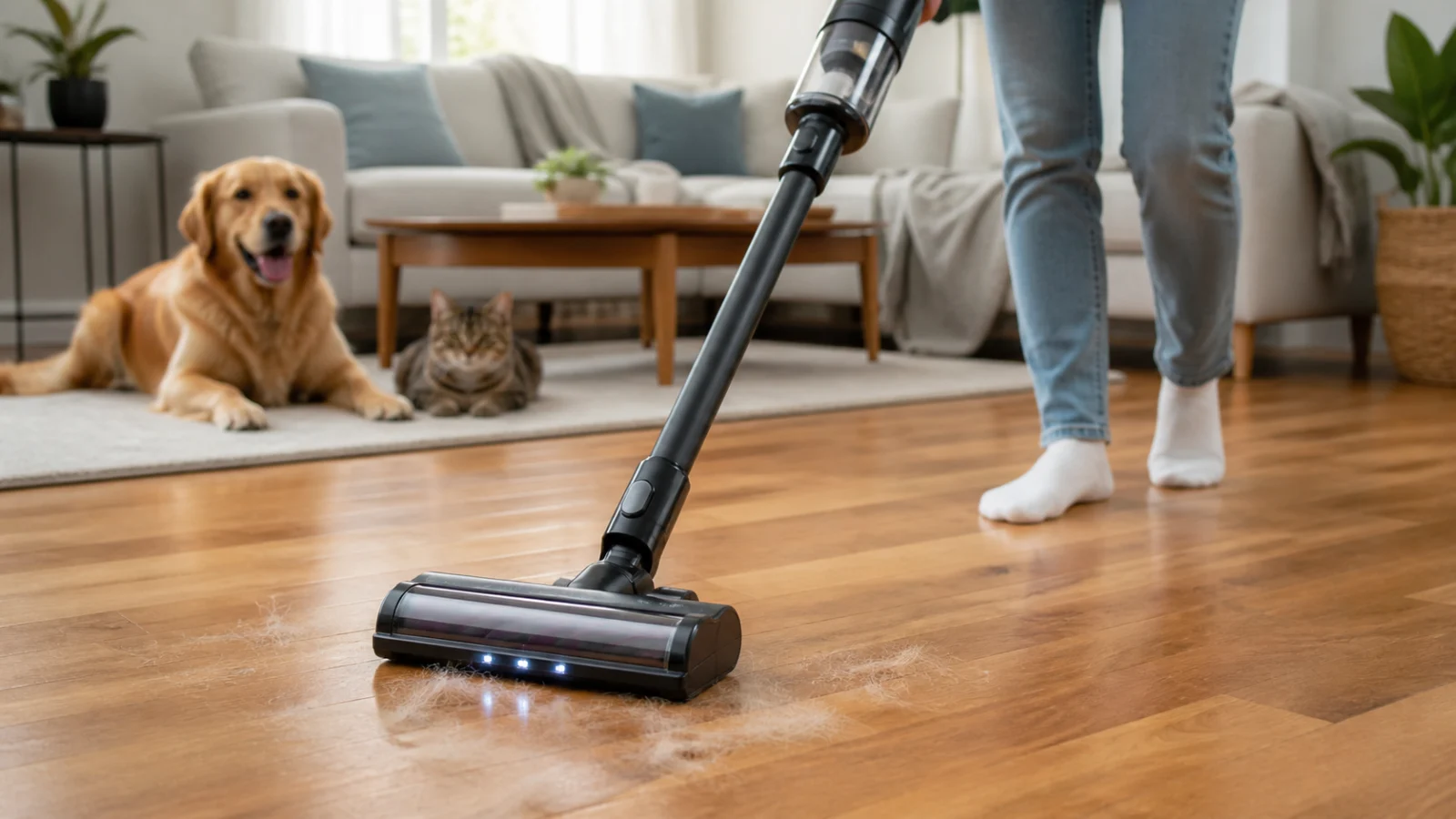
The best vacuum for pet hair and hardwood floors must pick up fur without scattering debris or scratching the finish. For homes that are mostly hard flooring, a canister with a dedicated hard-floor head is often the most capable choice. A cordless stick is easier for daily fur pickup, while a robot vacuum is a maintenance tool—not usually a replacement for deep cleaning.
Best vacuum type by household
| Home | Best starting type | Why | Trade-off |
|---|---|---|---|
| Mostly hardwood | Canister with hard-floor head | Strong pickup, controlled head, good reach | Bulkier to store and pull behind you |
| Daily visible fur | Cordless stick with soft roller | Fast and convenient | Battery ages; small bin |
| Hardwood plus rugs/carpet | Canister or upright with brush control | Adapts between surfaces | Heavier than a stick |
| Allergy-sensitive household | Sealed bagged vacuum with high-grade filter | Less dust exposure during disposal | Ongoing bag/filter cost |
| Ongoing maintenance | Robot plus full-size primary vacuum | Runs frequently under furniture | Needs obstacle prep and periodic deep cleaning |
| Furniture and car | Primary vacuum with powered mini tool | Agitates hair from upholstery | Small handheld alone is inefficient for floors |
Features that matter most
A floor head that protects wood
Hardwood does not need an aggressive carpet brush. Look for a soft roller, a suction-only parquet head, or the ability to switch the brush roll off. Inspect wheels and the bottom plate for trapped grit before each session, because debris dragged beneath the head can scratch a finish.
Pet-hair pickup on every surface you own
Hair on a bare floor is relatively easy to collect; embedded fur in rugs, carpet, stairs, and upholstery is the harder test. Match the main vacuum to the most demanding surface, then confirm it has a crevice tool and upholstery or mini motorized tool.
Anti-tangle design you can still clean
Hair-resistant rollers reduce maintenance but are not maintenance-free. Long human hair and pet fur can still wrap around bearings and end caps. Choose a head that opens easily and has replacement rollers or belts available.
Sealed filtration
A high-grade filter helps only if air is not leaking around the body. Look for a sealed or whole-machine filtration claim supported by the manufacturer, then follow the filter replacement schedule. Bagged systems usually expose the user to less dust during disposal than shaking out an open bin.
Manageable weight and noise
A powerful machine left in the closet removes no fur. Consider stairs, storage, reach under furniture, steering, cord length, and whether the noise frightens your pet. Keep animals in another safe room while vacuuming if they chase, attack, or panic around the machine.
Current model families worth comparing
Availability and model numbers change by country, so treat these as comparison starting points rather than a permanent ranking:
- Miele Complete C3/Compact canister families: compare the included parquet head, filtration package, bag availability, and carpet tool.
- Dyson cordless families with a soft hard-floor head: compare actual runtime with a powered head, bin size, battery replacement, and included hair tool.
- Shark PowerDetect/Stratos families: compare brush-roll shutoff or floor detection, roller cleaning access, weight, and current warranty.
- SEBO canister families: compare hard-floor head, sealed bag system, local dealer service, and parts support.
- Robot vacuums from established serviceable brands: prioritize obstacle avoidance, brush access, consumable availability, privacy controls, and a dock that fits your space.
PetUpon has not independently lab-tested every current configuration. We do not assign fabricated star scores. Confirm the exact model, included head, voltage, warranty, flooring compatibility, and return policy before purchase.
Bagged vs bagless for pet homes
Bagged vacuums generally hold more debris and allow cleaner disposal, which is useful when fur carries dander and dust. Bagless models avoid buying bags and make it easy to see when the bin is full, but emptying can release particles. If choosing bagless, empty outdoors when practical and clean filters exactly as directed; installing a damp filter can damage the machine or encourage odor.
Cordless runtime: read the fine print
Maximum advertised runtime is often measured in a lower-power mode without the most demanding attachment. Pet hair on rugs may require a powered head and higher suction, reducing runtime. Compare replaceable-battery cost, charge time, warranty, and performance as the bin and filter load—not just the largest minute number on the box.
How to remove pet hair efficiently
- Brush your pet with a coat-appropriate tool before loose hair spreads; see our dog shedding brush guide.
- Pick up toys, cords, and hard objects that can jam a roller.
- Inspect the floor head for grit that could scratch wood.
- Vacuum edges and upholstery first, then floors, using slow overlapping passes.
- Switch off an aggressive brush roll on bare flooring unless the maker approves it.
- Empty the bin or replace the bag before airflow drops.
- Remove wrapped hair and service filters on schedule.
Vacuuming manages shed hair but does not treat excessive shedding. Sudden hair loss, bald patches, itching, redness, sores, or odor needs veterinary assessment.
What to avoid
- A floor head with stiff dirty wheels or exposed hard edges
- A powered brush that cannot be disabled on delicate flooring
- Obscure models with unavailable filters, batteries, or rollers
- Assuming “HEPA filter” means the entire machine is sealed
- Using steam or wet modes unless the flooring manufacturer explicitly permits them
- Letting pets chew cords, attack the vacuum, or interfere with a robot
- Buying solely from affiliate star rankings with no test method
Frequently asked questions
Is a stick vacuum enough for pet hair?
It can be enough for a small mostly-hard-floor home and frequent light cleaning. Carpet, heavy shedding, multiple pets, and large homes often justify a full-size primary vacuum.
Will a vacuum scratch hardwood?
Any head can scratch if grit is trapped beneath it or if hard parts contact the finish. Use an approved hard-floor head, inspect it regularly, and follow the floor maker’s directions.
Do robot vacuums work for dog hair?
Frequent automated passes help control loose fur, but robots need maintenance and do not replace stairs, upholstery, edges, or periodic deep cleaning. Supervise early runs and manage pet accidents before the robot encounters them.
Is HEPA necessary?
High-efficiency filtration can help reduce fine particle emissions, especially in a sealed system, but a vacuum is not medical treatment. People with allergies or asthma should follow clinician advice and consider the entire cleaning and ventilation plan.
Bottom line
Choose a serviceable vacuum around your floors and hardest cleaning task. A canister with a dedicated hard-floor head offers excellent control; a cordless stick makes daily fur pickup easier; a robot supports maintenance. Safe floor contact, sealed filtration, brush control, and available parts matter more than a “pet” label.
Sources
- Consumer Reports: vacuum buying guide
- Consumer Reports: vacuums for hardwood floors
- AKC: managing dog shedding