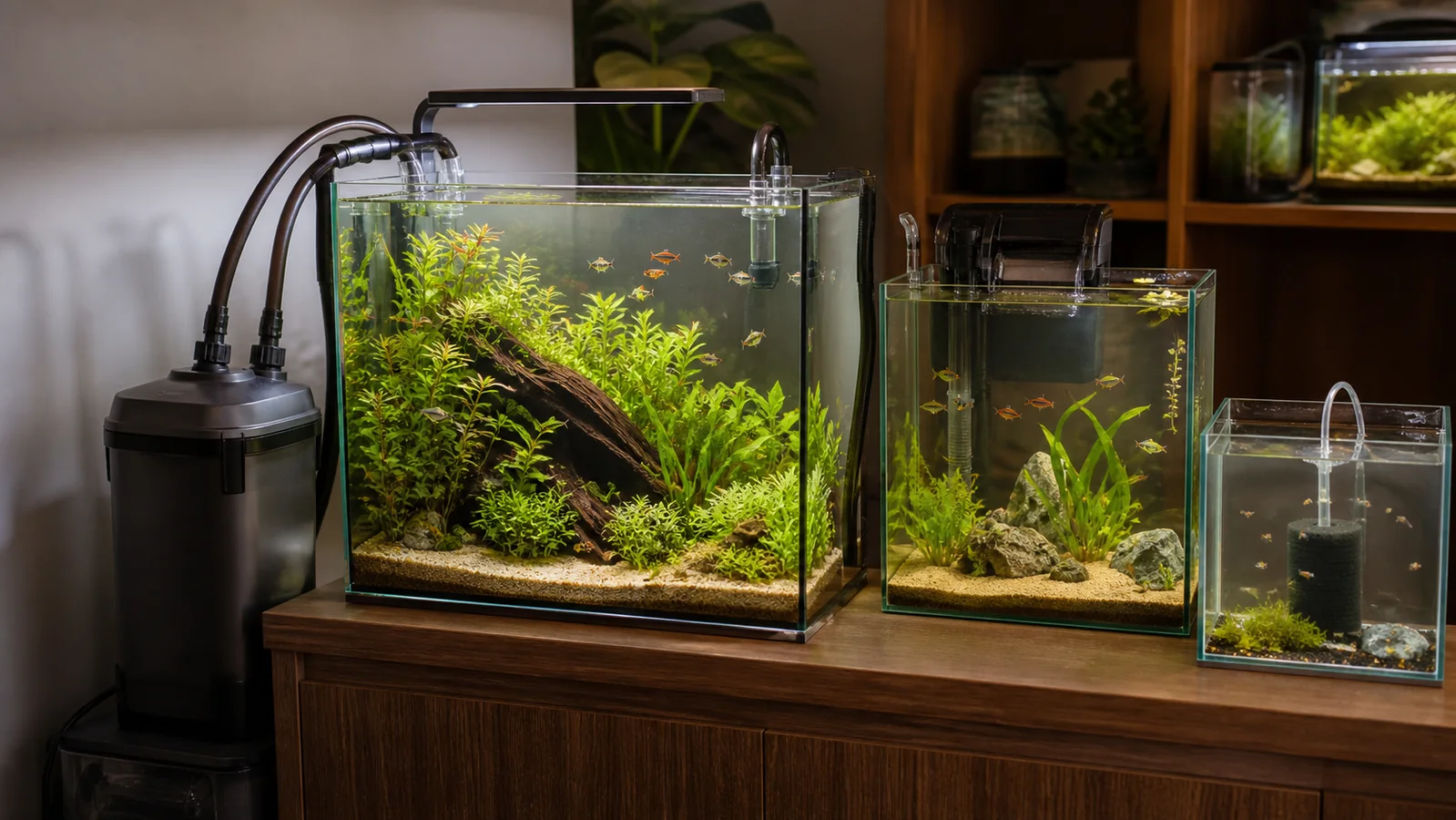
Canister, hang-on-back (HOB) and sponge filters can all support healthy aquariums. The best choice is the one that provides stable biological filtration, suitable current and a maintenance routine you will actually keep.
At-a-glance comparison
| Type | Strengths | Trade-offs | Often suits |
|---|---|---|---|
| Canister | Large media capacity, flexible outlets | More parts, hoses and setup | Medium/large tanks, tidy display |
| HOB | Accessible, simple installation | Visible box, waterfall/noise varies | General freshwater aquariums |
| Sponge | Gentle, fry/shrimp safe, inexpensive | Visible, limited mechanical polishing | Breeding, quarantine, backup |
Choose by maintenance
A canister may go longer between service but takes more steps to open. A HOB keeps media easy to inspect. A sponge is cleaned by squeezing it gently in removed aquarium water. In every case, preserve mature biological media and avoid replacing everything on the same day.
When combining filters helps
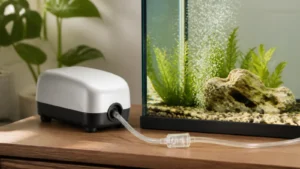
A sponge beside a canister or HOB adds aeration, gentle biological capacity and redundancy. It can also be moved to a quarantine tank once seeded, provided biosecurity is appropriate.
Related PetUpon guides
Best canister filters, best HOB filters, and filter buying guide.
Media capacity and water polishing
Canisters generally provide the most room to arrange coarse mechanical media first, biological media next and optional chemical media last. HOB filters vary widely: models with baskets are more flexible than cartridge-only designs. Sponge filters devote most of their volume to biological filtration and coarse particle capture. They are excellent for stability and gentle flow, but fine suspended particles may remain visible unless another filter or fine temporary media is used.
Do not assume a disposable cartridge is the biological filter’s entire life cycle. If a design allows, preserve mature reusable media and change exhausted chemical inserts separately. Any modification must maintain safe water flow and follow the equipment instructions.
Noise, leaks and power-outage behavior
A canister’s motor is often quiet once air is purged, but hoses and seals create leak points that need inspection. A HOB can hum or splash when the tank level falls. A sponge filter shifts the sound to the air pump; a soft mat and correct airflow can reduce vibration. After a power interruption, verify that powered filters restart and move water. Never presume a filter has automatically primed itself.
Three common aquarium scenarios
- Shrimp or fry: an air-driven sponge offers gentle flow and a safe grazing surface.
- Planted community display: a basket-style HOB or modest canister can hide equipment while distributing nutrients, provided the outlet is not excessive.
- Large, heavily fed fish: prioritize media volume, accessible mechanical cleaning and redundancy; a canister plus a secondary filter may be easier to manage.
How to verify that the change is working
Change one variable at a time and record the starting condition before adjusting equipment or routine. Note water-test results, temperature, livestock behavior, feeding, visible waste or algae, and the exact setting that changed. Recheck at a consistent time rather than reacting to a single observation immediately after maintenance. This creates evidence you can compare and prevents repeated changes from hiding the real cause.
Animal behavior is an important signal but not a substitute for measurements. Normal swimming, breathing and feeding should be considered alongside ammonia, nitrite, temperature and species-specific chemistry. If animals gasp, lose balance, develop lesions or die unexpectedly, treat it as a health or water-quality problem—not an equipment shopping problem—and seek qualified help.
Responsible equipment decisions
Buy for the mature aquarium, not only its current appearance. Confirm electrical certification, warranty, replacement parts, cleaning access and the manufacturer’s operating limits. Keep manuals and purchase dates in the maintenance log. Before replacing working equipment, identify the outcome you need and the measurement that will show improvement. A more expensive device cannot correct overcrowding, incompatible livestock, untreated source water or inconsistent husbandry.
After any installation, inspect cables, drip loops, leaks, unusual heat, vibration and restart behavior. Keep electrical connections dry and disconnect power before putting hands near damaged or exposed equipment. When the manufacturer’s instructions conflict with a general rule in this guide, follow the instructions for the exact model.
Frequently asked questions
Which filter is quietest?
Design, installation and maintenance matter more than type alone. A submerged, correctly purged canister may be quiet; a HOB water drop or air pump can be audible.
Is a sponge filter enough?
It can be for lightly stocked, suitable aquariums when sized correctly and maintained, but it provides less water polishing than many powered filters.
Which is safest for shrimp?
Sponge filters are naturally intake-safe; powered filters need a fine pre-filter sponge that is cleaned regularly.
Sources and editorial notes
- Aqueon: Freshwater Aquarium Water Quality
- Aqueon: The Nitrogen Cycle
- Fluval: Choosing a Freshwater Filter
PetUpon provides general aquarium education. Species needs and equipment instructions take priority; seek an aquatic veterinarian for illness or unexplained losses.