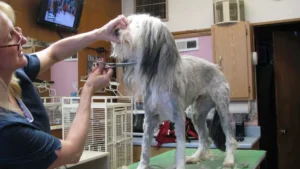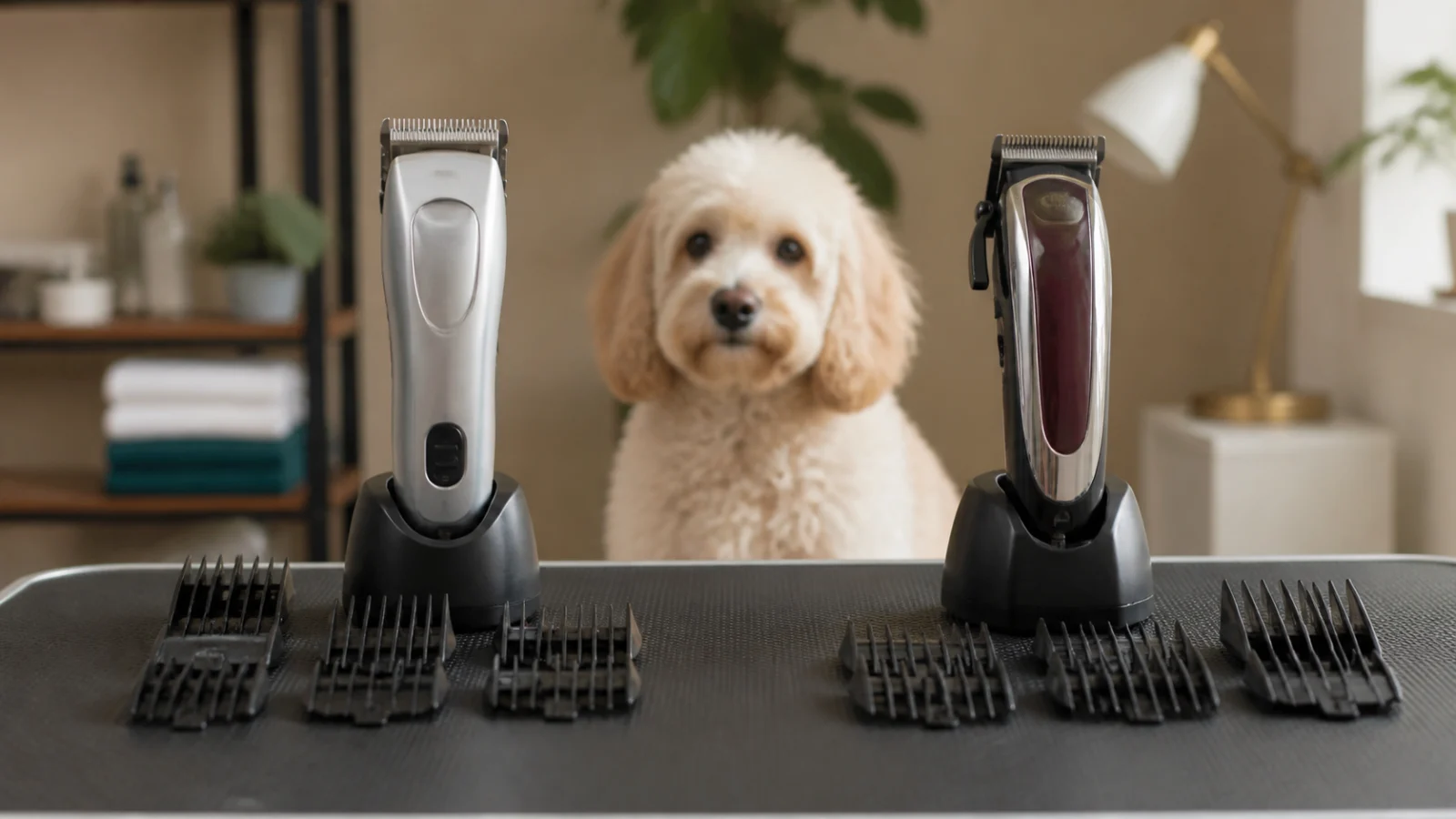
Human hair clippers and dog grooming clippers look similar, but they are built for different material and working conditions. Human clippers are intended for relatively fine, uniformly arranged human hair. Dog clippers must move through coat that may be dense, curly, double-layered, or continuously growing, while running long enough to complete a body groom. For a full dog haircut, use a pet clipper rated for your dog’s coat.
Human clippers vs dog clippers
| Feature | Human clippers | Dog clippers |
|---|---|---|
| Designed material | Human scalp and facial hair | Varied canine coat textures and densities |
| Typical workload | Shorter passes over a relatively flat scalp | Longer sessions across a moving body and multiple coat directions |
| Blade system | Brand-specific human blades and guards | Pet blades/guide combs; professional models may use detachable systems |
| Coat capacity | May clog or pull in dense coat | Models available for fine, curly, long, or double coats |
| Noise/heat | Varies; not automatically quieter or cooler | Varies; animal models often prioritize continuous grooming and handling |
| Best use on dogs | Generally avoid for full grooming | Choose by coat, task, and manufacturer guidance |
Why dog coat needs different equipment
Canine coat is not one category. Smooth single coats, dense undercoats, drop coats, wire coats, and curly continuously growing coats behave differently under a blade. A lightweight human trimmer that works on fine hair may fold or pull a soft undercoat and clog with loose fur. More power alone is not the whole answer: blade sharpness, tooth design, cooling, coat preparation, and technique all affect performance.
Professional-style dog clippers often accept detachable blades and compatible guide combs. This lets a groomer choose a safe working length and rotate clean blades as they warm. Small pet trimmers prioritize maneuverability for limited detail work, but they should not be assumed capable of a full dense coat.
Five practical differences that matter
1. Blade and guard compatibility
Human guard numbers do not translate reliably to dog-grooming blade lengths. Do not infer a finished length from a different brand or tool category. Use the pet clipper manufacturer’s chart and begin conservatively.
2. Torque through coat
Dog clippers intended for long, curly, or double coats are designed for a more demanding load. If a clipper slows, pulls, or chatters, stop. Forcing it hurts the dog and can damage equipment.
3. Heat management
Any moving blade can get hot, including an expensive animal clipper. Check it against the inside of your wrist often, remove packed hair, follow lubrication instructions, and rotate blades during long sessions. A cooling product does not replace temperature checks.
4. Noise, vibration, and shape
Dogs experience the sound and vibration directly against their body. A quieter detail trimmer may help with gradual training, while a balanced full-size clipper can be easier to control on the torso. Select the tool for the task rather than expecting one unit to excel everywhere.
5. Service and replacement parts
A clipper is a system: blades, guide combs, oil, cleaning, sharpening, batteries, and repair support matter. Buy a current model with parts available in your region instead of choosing solely by marketplace ratings.
Can you ever use human clippers on a dog?
For safety and predictable results, a pet-specific tool remains the recommendation. If an owner uses a human trimmer for a very small external touch-up, it must be clean, sharp, cool, and moved only through fully combed coat away from eyes, lips, ears, paws, folds, genitals, and other high-risk areas. Stop immediately if it pulls or the dog moves.
Do not share a tool between humans and animals without appropriate cleaning, and do not use human clipper guards as a substitute for dog-grooming instruction. A low-cost pet trimmer designed for limited details is the more sensible purchase.
When neither clipper is safe at home
- Tight mats or pelting close to the skin
- Red, infected, wounded, or painful skin
- A dog that bites, panics, twists, or cannot remain safely positioned
- Work around eyelids, lips, ear folds, armpits, groin, paw webbing, or genitals without training
- A coat whose correct technique you do not understand, including hand-stripped wire coats
See why tight mats need special handling. A groomer can assess coat and behavior; a veterinarian should assess pain, infection, sores, or severe matting.
How to choose a dog clipper instead
- Identify coat type and whether the job is a full haircut or detail trim.
- Confirm the manufacturer rates the model for that coat and workload.
- Choose a maintainable blade system with parts available locally.
- Consider corded power for full grooms and a cordless detail tool for small areas.
- Budget for spare blades, guide combs, oil, cleaning, and professional sharpening.
- Ask a breed-experienced groomer to demonstrate safe lengths and technique.
Our dog clipper buying guide explains current body-clipper choices. Owners of dense coats should also read our guide for thick and double coats.
Preparing the coat matters more than expected
Even the correct dog clipper performs poorly on dirty, damp, tangled coat. Inspect the skin, remove only manageable tangles before bathing, wash with dog-safe products, rinse completely, dry safely, then brush and comb to the skin. Do not force a guide comb through resistance. Follow the full sequence in our home grooming guide.
Frequently asked questions
Are dog clippers sharper than human clippers?
“Sharper” is not a useful universal comparison. Both need sharp, correctly aligned blades. Tooth geometry, blade system, motor behavior, coat preparation, and intended workload differ by model. A dull dog blade can pull just as a mismatched human clipper can.
Can I use dog clippers on human hair?
Use tools for their labeled purpose. Cross-use can create hygiene, guard-length, warranty, and performance problems. A human clipper is the appropriate, more predictable tool for human hair.
Why do my dog clippers leave lines?
Common causes include dirty or damp coat, tangles, inconsistent pressure or direction, a dull blade, poorly seated guide comb, or coat not dried straight. Stop if the tool pulls; do not repeatedly pass over irritated skin.
Do expensive clippers stay cool?
No blade is heat-proof. Professional tools may manage demanding work better, but friction still creates heat. Frequent checking and blade rotation remain essential.
Bottom line
Use human clippers for human hair and a coat-appropriate pet clipper for dog grooming. The correct dog tool offers a blade system, power profile, handling, and service options designed for canine coat. Safe preparation and technique—not improvising with the nearest trimmer—produce the best result.
Sources
- AKC: dog grooming at home
- AKC: how to groom a dog
- Wahl Professional Animal: current clipper categories