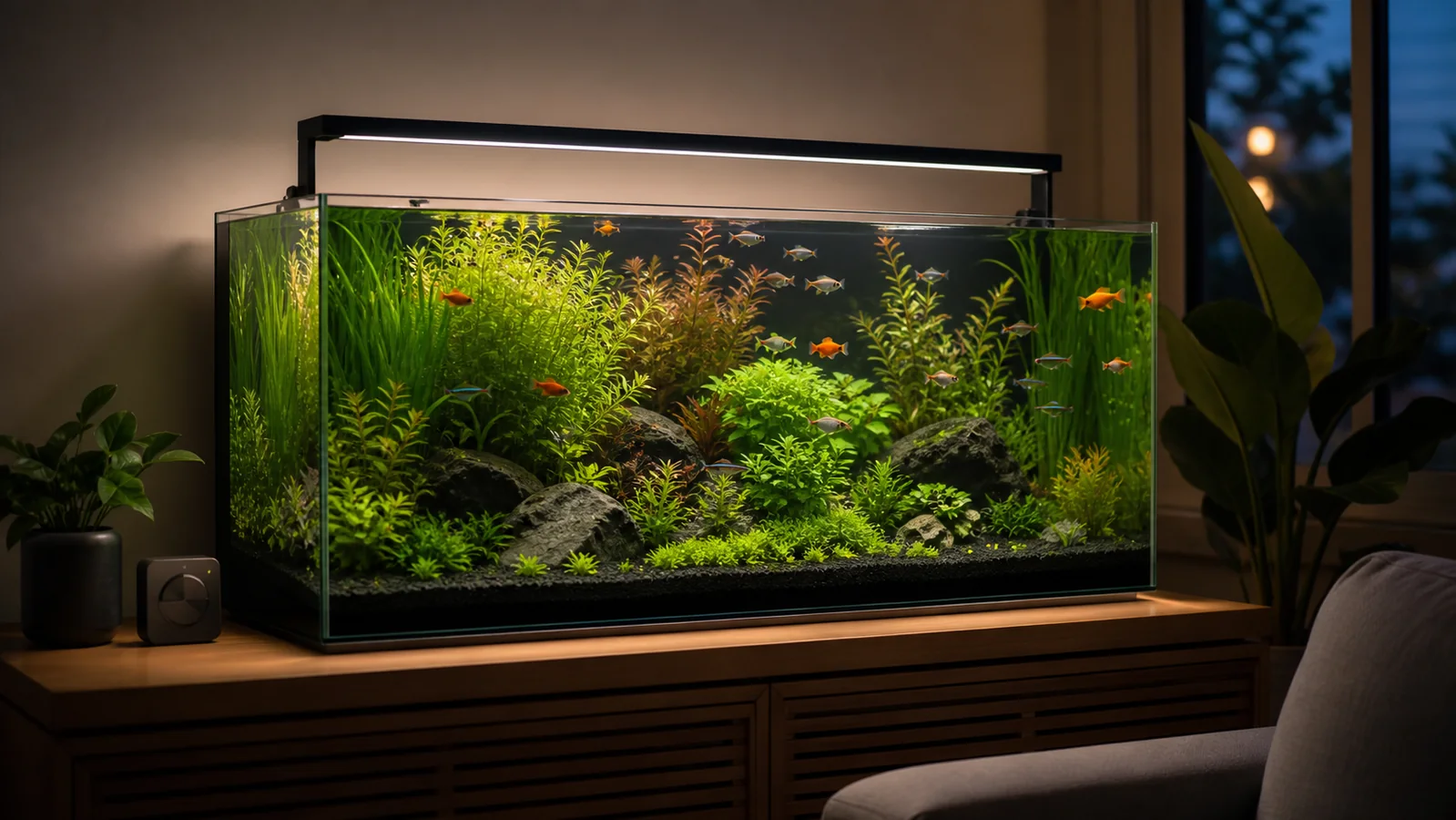
A consistent light schedule is more useful than changing duration every day. For many planted freshwater aquariums, six to eight hours is a conservative starting range, but plant species, light intensity, nutrients, carbon availability and ambient daylight all change the result.
Start, observe, adjust
| Observation | Possible response |
|---|---|
| Plants stable, limited algae | Keep the schedule consistent |
| Algae increasing | Check sunlight, intensity, nutrients and maintenance before extending light |
| Plants stretching or declining | Confirm plant needs and fixture output; adjust gradually |
| Fish hiding at switch-on | Add cover and reduce abrupt intensity if the fixture permits |
Fish need darkness too
Provide a predictable dark period. Avoid leaving bright aquarium lights on overnight. A brief viewing light should not become an all-night photoperiod, and room light or sun through a window also contributes to the daily light environment.
Reef and planted tanks differ
Corals have species- and system-specific intensity and spectrum requirements, often measured and acclimated carefully. Do not copy a freshwater timer schedule into a reef aquarium. Follow livestock needs and fixture guidance.
Related PetUpon guides
Compare freshwater LED aquarium lights and reef lighting.
Separate duration from intensity
Photoperiod is only one part of lighting. A powerful fixture for six hours can deliver more light than a modest fixture for eight. Mounting height, water depth, floating plants and tannins also alter what reaches leaves or corals. If the fixture is dimmable, begin conservatively and adjust either intensity or duration—not both at once—then observe for at least one to two weeks.
Build a repeatable observation log
| Track weekly | What it can reveal |
|---|---|
| New plant growth | Whether light and nutrition support the chosen species |
| Algae location/type | Whether sunlight, dead spots or imbalance may contribute |
| Fish behavior | Need for shade, cover or a gentler transition |
| Timer and fixture heat | Equipment reliability and ventilation issues |
Example freshwater routine
Choose a viewing window that matches the household, such as late afternoon through evening, and program one consistent six-hour block. Shield the aquarium from direct sun. If plants grow steadily and algae remains manageable, keep it unchanged. If plant needs justify more light, add about 30 minutes and reassess rather than jumping several hours. A midday pause is usually unnecessary unless it solves a clear household schedule problem.
Safety and maintenance
- Use a fixture rated for aquarium humidity and the tank dimensions.
- Create drip loops and keep power connections away from splash zones.
- Clean salt creep and mineral deposits only when unplugged.
- Do not cover ventilation openings.
- Acclimate livestock and corals when replacing a fixture with a stronger model.
How to verify that the change is working
Change one variable at a time and record the starting condition before adjusting equipment or routine. Note water-test results, temperature, livestock behavior, feeding, visible waste or algae, and the exact setting that changed. Recheck at a consistent time rather than reacting to a single observation immediately after maintenance. This creates evidence you can compare and prevents repeated changes from hiding the real cause.
Animal behavior is an important signal but not a substitute for measurements. Normal swimming, breathing and feeding should be considered alongside ammonia, nitrite, temperature and species-specific chemistry. If animals gasp, lose balance, develop lesions or die unexpectedly, treat it as a health or water-quality problem—not an equipment shopping problem—and seek qualified help.
Responsible equipment decisions
Buy for the mature aquarium, not only its current appearance. Confirm electrical certification, warranty, replacement parts, cleaning access and the manufacturer’s operating limits. Keep manuals and purchase dates in the maintenance log. Before replacing working equipment, identify the outcome you need and the measurement that will show improvement. A more expensive device cannot correct overcrowding, incompatible livestock, untreated source water or inconsistent husbandry.
After any installation, inspect cables, drip loops, leaks, unusual heat, vibration and restart behavior. Keep electrical connections dry and disconnect power before putting hands near damaged or exposed equipment. When the manufacturer’s instructions conflict with a general rule in this guide, follow the instructions for the exact model.
Frequently asked questions
Should aquarium lights stay on all day?
Usually no. A timed photoperiod with a meaningful dark period is healthier and easier to manage.
Can I split the lighting period?
It is possible, but a simple consistent block is easier to evaluate. Change only one variable at a time.
Does blue light prevent algae?
No color setting guarantees algae control. Total intensity, duration, nutrients, maintenance and sunlight all matter.
Sources and editorial notes
- Aqueon: Freshwater Aquarium Water Quality
- Aqueon: The Nitrogen Cycle
- Fluval: Choosing a Freshwater Filter
PetUpon provides general aquarium education. Species needs and equipment instructions take priority; seek an aquatic veterinarian for illness or unexplained losses.